AI for SMEs in Como: reduce time wasted on documents, quotes and warehouse tasks
AI in your company doesn't start with a €50,000 platform. It starts with a concrete problem and a spare PC nobody cares about. Ollama, llama.cpp, and you're off.

Is your SME losing hours across PDFs, emails, quotes, procedures and warehouse requests?
Yes. I know. Everyone knows.
AI can help. But you don't need a huge platform, a €50,000 project, or the usual generic chatbot that can talk about everything and knows nothing about your company.
The only sensible way is one: start from a single repetitive task. The one wasting time, creating mistakes, or delaying a customer response.
For many manufacturing and logistics SMEs in Como, Lecco and Lombardy, that's where a small AI tool delivers the first concrete result. Not before.
Do not buy AI: solve a problem

Wrong question: "How do we add AI to the company?"
Right question: "Which repetitive activity costs us the most time every week?"
A good first project is simple to describe and simple to measure. Like:
- A salesperson searching old quotes and price lists every time before replying to a client.
- A technician digging through manuals and procedures to find an answer.
- Warehouse staff checking codes, locations or instructions with both hands busy.
The goal isn't replacing people. It's getting the right information faster to the person who has to decide. Which is a much less sexy story to tell. And much more useful.
Three practical SME use cases
1. An assistant that reads manuals and procedures
Load technical manuals, operating instructions, product sheets and approved procedures. The operator asks a question, gets an answer with document references.
If the information isn't there, the assistant must say so. Not make it up. Ever. Because an assistant that invents a safety procedure is worse than no assistant.
2. Quote and customer-response drafts
AI reads a request, extracts data from PDFs and emails, prepares a first draft to review. The salesperson keeps the final word on price, margin, timing, terms.
Always.
3. Warehouse support
A simple tablet or terminal interface helps staff find a procedure, verify a code, complete a guided movement.
But first fix data and flows. If the warehouse is chaos, AI makes the chaos faster. That's not an improvement.
What local AI actually means
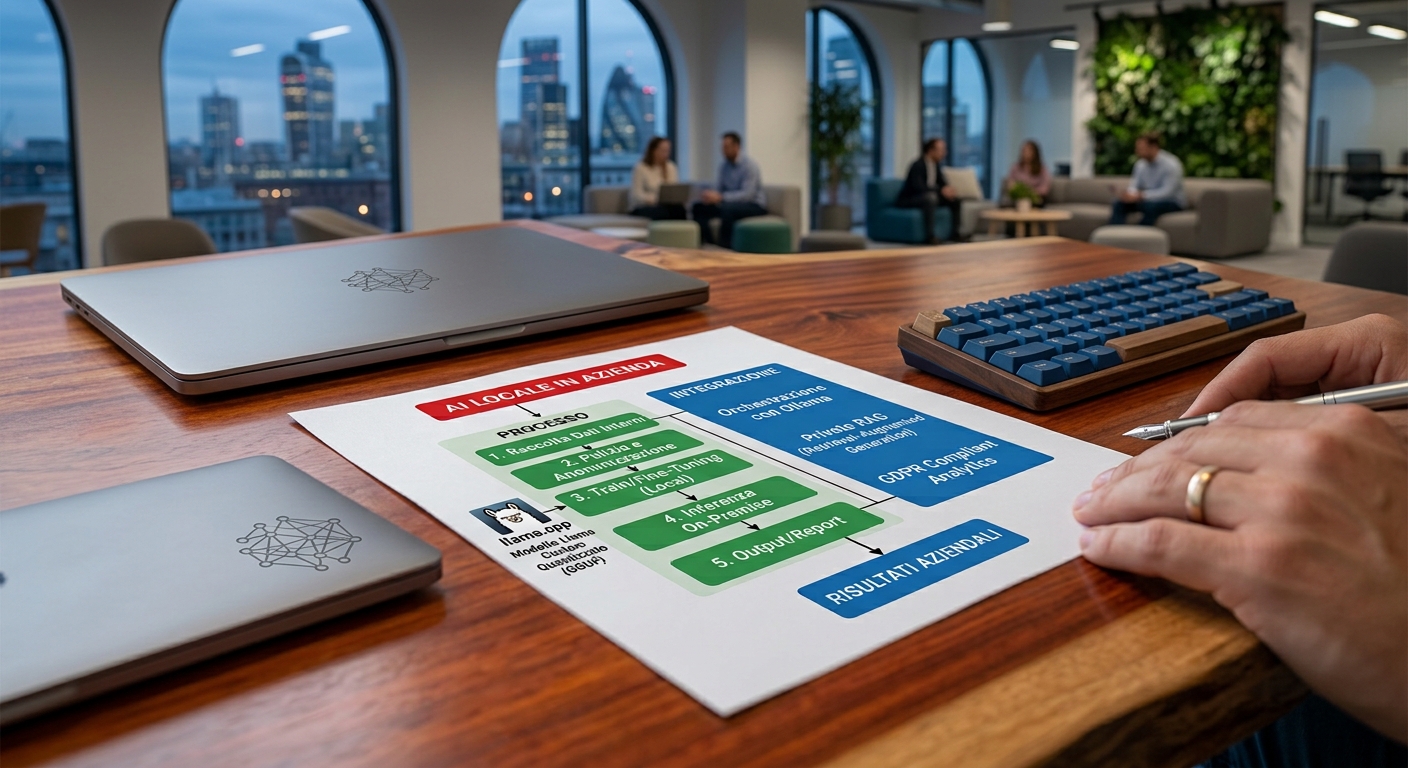
When you use an online AI service, documents and prompts can leave your company infrastructure.
In many cases that's not acceptable. Price lists, client data, procedures, drawings, confidential information. Stuff you don't want running on someone else's server.
With a model running locally, AI runs on a dedicated PC or internal server. Ollama starts and runs local models. llama.cpp is the lightweight engine that executes them efficiently. Your business application queries the AI on the internal network, with controlled access and sources.
It's not magic. It's not automatic security. You need authorized users, permissions, backups, proper configuration. But it's a concrete way to have more controllable AI tools, less dependent on external subscriptions.
And above all: your data stays yours.
Start without wasting budget
-
Pick one narrow problem. Not "let's digitize the warehouse". But "let's cut the time to find a goods-receiving procedure".
-
Measure the current state. How many minutes? How many times a week? Where do errors come from?
-
Prepare a small set of reliable sources. Better 30 updated PDFs than thousands of old, messy files. Disorder doesn't become magic just because you put it inside an LLM.
-
Build a pilot with human approval. AI proposes, the person checks and decides. No automatic changes to critical systems in phase one. Zero.
-
Evaluate the result. Compare time, errors, requests handled before and after. If it works, integrate deeper. If it doesn't, you've limited cost and risk. And above all: you learned something without breaking anything.
Office agents or industrial AI?
For a mechanical, manufacturing or logistics SME, talking about AI applied to processes makes more sense than selling the usual chatbot. The owner thinks about quotes, quality, deliveries, procedures, downtime, margins. Not about "how do I write nicer emails".
But the first project doesn't have to be a camera on the line or a system wired into the machines. Often the most effective start is an assistant for documents, technical office, sales or warehouse. Less invasive. Easier to test. And useful to check if your company data is ready.
Computer vision, IoT and machine integration come later. When there's a specific physical problem. And when the return justifies the work.
Not before.
Where to start
Before choosing software or AI models, answer five questions:
- Which manual activity wastes the most time every week?
- What documents or data are needed to perform it?
- Who can verify the AI's answer is correct?
- What result can we measure within 30-60 days?
- What data must stay inside the company, no exceptions?
If you can't answer these five, you're not ready for AI. You're ready for consulting. Which is a different thing.
I build private AI tools for manufacturing and logistics SMEs in Como and Lombardy. Start from a concrete process. Build a measurable pilot. Integrate only when it delivers a real result.
Useful AI isn't the one that makes the most noise. It's the one that saves people time without making them lose control. The rest is LinkedIn fluff.